The Left-Brain / Right-Brain Myth, Debunked
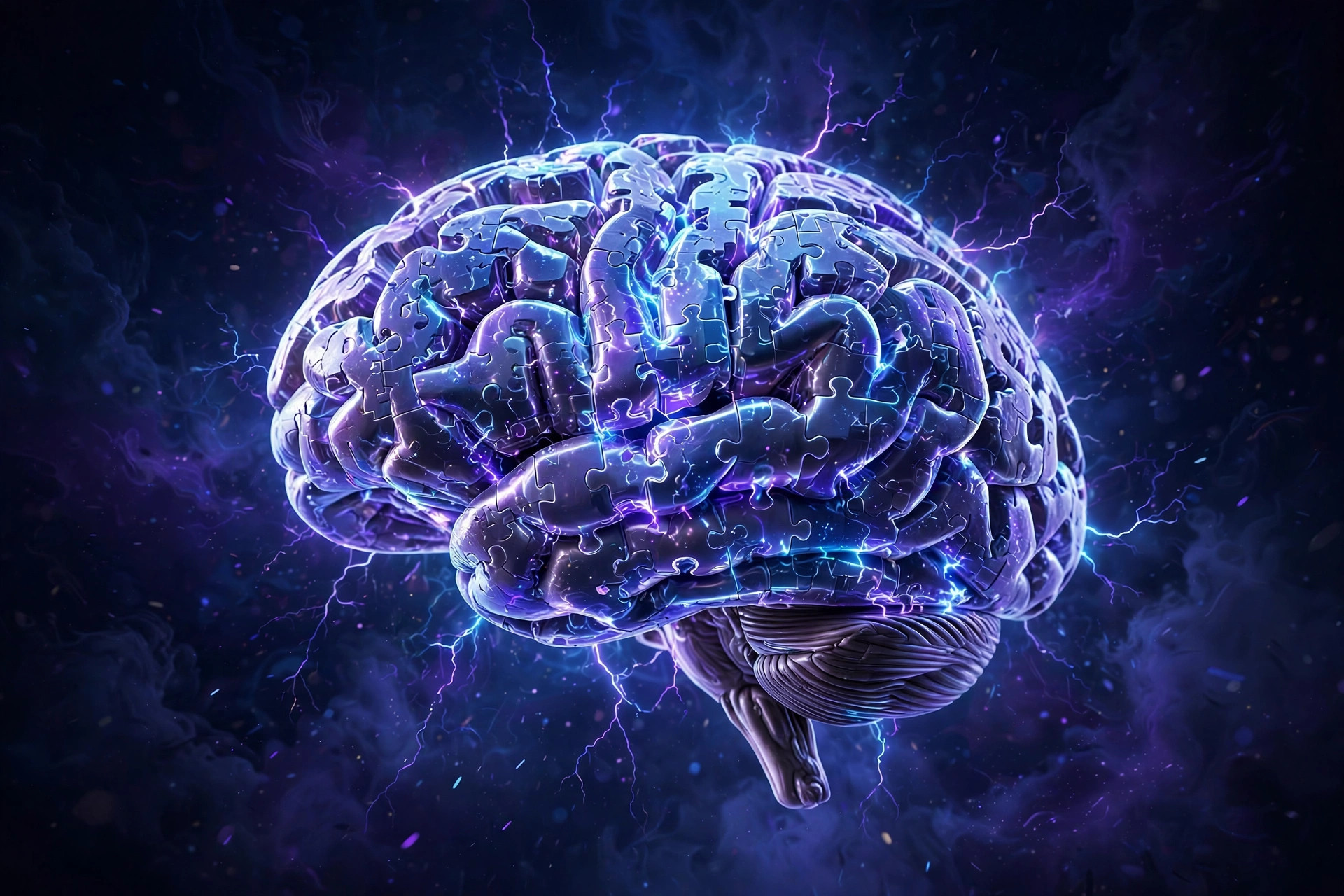
You know the pitch: left-brained people are logical, analytical, and good with numbers; right-brained people are creative, intuitive, and artistic. Personality quizzes ask which one you are. Corporate workshops divide the room by it. The idea feels so true that questioning it feels like questioning gravity.
Here's the problem: it's wrong. Not "slightly oversimplified" wrong — wrong in the way it matters most. The question "are you left-brained or right-brained?" has no scientific answer, because the two hemispheres don't work that way in a healthy brain. Let's walk through where the myth came from, what the real research actually showed, and what to think instead.
The Myth
The myth's claim is clean and memorable: your personality and talents are determined by which hemisphere of your brain "dominates." Left-brain dominant people think in words and logic; right-brain dominant people think in images and feelings. Each half, in this telling, is a kind of separate mind with its own character — the accountant and the artist sharing a skull.
It's an appealing story. It gives people a ready-made identity ("I'm a right-brain person, that's why I'm bad at math"), and it gives quiz-makers a ready-made product. But appealing isn't the same as true.
Where It Came From: Split-Brain Research
The myth has a real scientific origin, which is what makes it so sticky. In the 1960s, researchers — most famously Roger Sperry, working with colleagues including Michael Gazzaniga — studied epilepsy patients who had undergone a dramatic surgery: their corpus callosum, the thick bundle of fibers connecting the two hemispheres, had been surgically severed to stop seizures from spreading across the brain.
In these "split-brain" patients, the hemispheres genuinely could operate semi-independently. Sperry's experiments showed striking effects: an image shown only to the right hemisphere (via the left visual field) couldn't be named by the patient, because language production sits mostly in the left hemisphere — but the patient's left hand (controlled by the right hemisphere) could point to the matching object. Each half seemed to know things the other didn't.
This was groundbreaking neuroscience, and Sperry's work was recognized with a Nobel Prize. But here's the crucial part that got lost in translation: these patients had their hemispheres surgically disconnected. What happens when you cut the cable between two halves of a system tells you what each half can do alone — it does not tell you how the system works when the cable is intact. Nobody concluded this from the research; the public did, with the media's enthusiastic help.
What Neuroscience Actually Shows
In an intact brain — yours, presumably — the two hemispheres are in constant, massive communication through the corpus callosum. Modern brain imaging consistently shows that both complex and everyday tasks recruit networks spanning both sides:
- Logic and math use both hemispheres. Solving a math problem draws on left-hemisphere symbolic processing and right-hemisphere spatial and approximate-quantity processing.
- Creativity uses both hemispheres. Generating novel ideas involves distributed networks across the whole brain, not a "creative side" lighting up.
- Language uses both hemispheres. While grammar and speech production lean left for most people, understanding metaphor, humor, prosody (the "music" of speech), and narrative all draw heavily on the right.
There is no evidence that people fall into "left-brained" and "right-brained" types. Imaging studies that looked for exactly this — a dominant hemisphere pattern distinguishing one group of people from another — found that lateralization of activity is roughly equivalent across people, and that no one's brain is meaningfully "run" by one side.
Think of it this way: claiming you're left-brained because you're analytical is like claiming you're left-lunged because you breathe. Both halves are in on everything.
The Grain of Truth: Some Functions Do Lateralize
The myth isn't pure fiction — it's a distortion of something real. Lateralization is a genuine phenomenon: certain functions do lean toward one hemisphere more than the other. Language production leans left for the large majority of right-handed people (and most left-handers too). Some spatial processing leans right. Fine motor control of each hand is handled by the opposite hemisphere.
But "some functions lean one way" is a universe away from "you are a left-brained person." Lateralization describes tasks, not people. Everyone — every mathematician, every painter, every one of us — uses both hemispheres for both "logical" and "creative" thinking. The grain of truth is real; the personality typology built on top of it is not.
Why the Myth Survives
A myth this thoroughly debunked should have died decades ago. It survives for a few understandable reasons:
- It's a tidy story. "Two halves, two personalities" is easy to remember and easy to repeat. The real neuroscience — distributed networks, dynamic connectivity — is harder to summarize on a poster.
- Personality quizzes love it. "Which side are you?" is a perfect quiz hook, and an entire self-help industry grew up around the framing.
- It flatters everyone. Whichever side you claim, it comes with a compliment attached: logical or creative. Myths that make everyone feel special don't die quietly.
- The original research was real. Unlike pure pseudoscience, this myth has a Nobel Prize–adjacent origin story, which gives it a borrowed credibility that outlasts the nuance.
A Better Framing: Networks, Not Halves
So what should you think instead? Modern neuroscience suggests the useful unit of thinking isn't the hemisphere — it's the network. The brain is organized into distributed circuits that recruit regions from both sides as needed. Intelligence, creativity, and skill are properties of how well these networks communicate, not of which half is "in charge."
This is also why the question "can I become more creative?" has a better answer than "activate your right brain." Creativity, like logical reasoning, is a trainable set of skills — knowledge, practice, and habits of thought — running on the whole organ. If you've been blaming your left brain for your math struggles or crediting your right brain for your art, the good news is that neither half was ever the bottleneck.
Want to see what your reasoning actually looks like, instead of which mythical half "dominates"? Take the free IQ Challenge — 25 timed logic questions, instant estimated IQ and percentile. And if you're curious about the broader picture of what intelligence tests do and don't capture, read what IQ is, or our take on the EQ vs. IQ debate. Curious whether brain games can sharpen those networks? See does brain training work.
Try the IQ Challenge
Reading about intelligence is fun — testing your own logic is more fun. Take the free 25-question timed quiz and get your estimated IQ and percentile instantly.
Keep exploring: try the free IQ Challenge quiz, read our EQ vs. IQ explainer, learn what IQ actually measures, or see whether brain training works.
For entertainment only — this guide is for fun and general information, not a clinical or professional assessment.
© FUNGWA 峳華 LLC (fēng huá — “peaks of splendor”)